
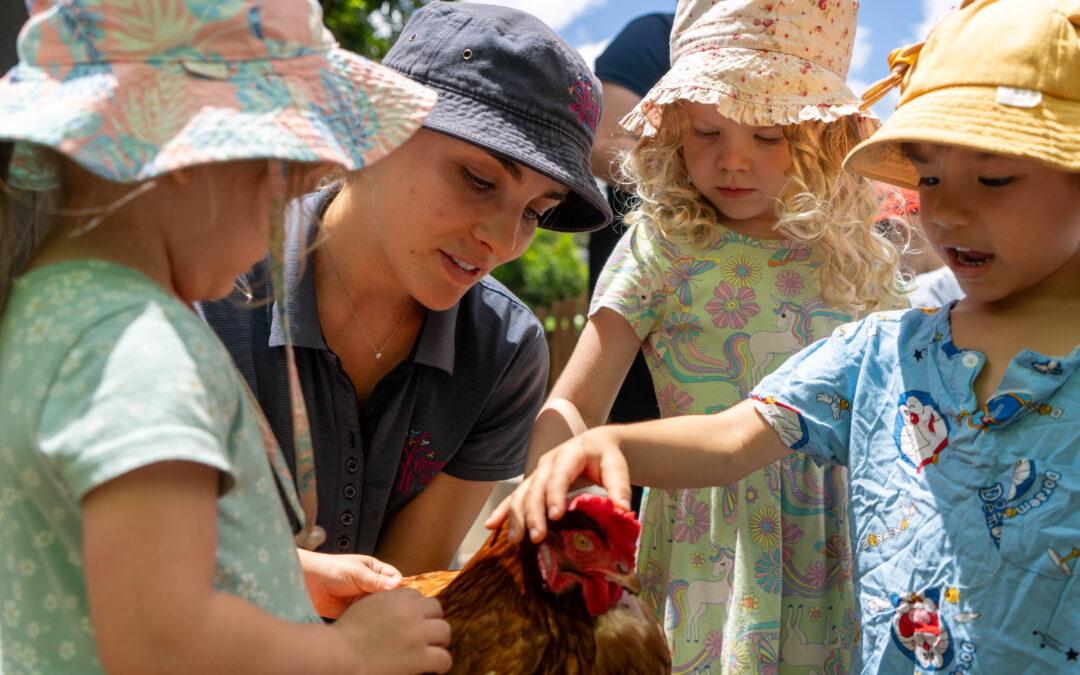
The habits a young child forms in their earliest years are not simply routines — they are the blueprints for a lifetime of health and wellbeing. At Kenmore Hills Early Learning, we understand that every meal shared, every moment of active play, every handwashing ritual, and every quiet rest time is quietly shaping the way a child will relate to their body, their energy, and their health for decades to come.
The beauty of building healthy habits in early childhood is that it does not require dramatic interventions or complicated programs. It requires consistency, intention, and an environment designed to make the healthy choice the natural choice.
Nourishing Little Bodies
Food in an early learning setting is never just fuel. It is a social experience, a cultural expression, a sensory adventure, and a daily opportunity to build a positive, curious relationship with eating. We approach mealtimes as a genuine part of the curriculum — sitting together, talking about what is on the plate, celebrating colour and variety, and modelling the kind of relaxed, adventurous attitude toward food that we hope children carry with them always.
Research from Eat for Health and the Australian Dietary Guidelines is clear: the food patterns established in the first five years of life have lasting implications for long-term health. Offering a wide variety of whole foods — plenty of vegetables, fruit, legumes, whole grains, and lean proteins — alongside warm, unpressured encouragement to try new things, builds both nutritional health and a genuinely positive food identity.
We also recognise that food is deeply cultural, and that healthy eating looks different across different families and traditions. Our approach celebrates that diversity rather than flattening it.
Movement as a Way of Life
Young children are designed to move. Their bodies are built for running, climbing, jumping, rolling, balancing, and exploring — and the physical literacy they develop through active, unstructured outdoor play in the early years forms the foundation for a lifelong relationship with movement and physical activity.
At our centre, outdoor play is not a break from learning — it is learning in its richest, most embodied form. Gross motor development, spatial reasoning, risk assessment, social negotiation, emotional regulation, and pure, uncomplicated joy all happen in the sandpit, on the climbing frame, and in the open grass of our outdoor spaces.
The Australian 24-Hour Movement Guidelines for the Early Years recommend that children aged three to five accumulate at least three hours of physical activity throughout each day. We build this into the rhythm of every session, ensuring that movement is woven naturally through the day rather than confined to a single designated time slot.
Sleep, Rest, and the Science of Recovery
In a culture that tends to celebrate busyness, rest can feel like an afterthought. But for young children, sleep and rest are not passive states — they are when the brain consolidates learning, the body repairs and grows, and the emotional system recovers from the stimulation of the day.
We create genuine rest opportunities within our daily rhythm — quiet reading time, relaxed sensory play, and designated sleep and rest periods for children who need them. We also share resources with families about the sleep needs of different age groups, because the habits built around rest at home are just as important as those we support at the centre.
Hygiene as Everyday Practice
Handwashing before meals and after toileting, covering coughs and sneezes, and caring for shared spaces are not merely infection-control measures — they are the earliest expressions of caring for oneself and for others. When educators frame these practices with warmth and consistency rather than urgency, they become second nature. A three-year-old who washes their hands independently and thoroughly is practising self-regulation, fine motor coordination, and community responsibility all at once.
Mental Health and Emotional Well-being
Healthy habits are not only physical. The mental health and emotional well-being of young children is equally foundational, and the routines and relationships within an early learning setting play a profound role in shaping it.
Predictable routines, warm and responsive relationships with educators, protected time for unstructured creative play, access to nature, and consistent emotional support all contribute to the kind of psychological safety that allows young children to thrive. When a child feels safe, connected, and regulated, everything else — learning, friendship, creativity, curiosity — flows more freely.
We also make a point of talking about feelings as a normal part of each day, normalising the full range of human emotion and building the emotional literacy that underpins lifelong mental wellbeing.
Partnership With Families
The most powerful healthy habits are those that are reinforced consistently across a child’s whole world — at the centre and at home. We warmly encourage families to talk with our educators about what their little one is enjoying at mealtimes, how their sleep is going, and what kinds of movement and outdoor time they are getting at home. These conversations allow us to work as genuine partners in each child’s health and development, rather than as separate, disconnected environments.
Small, consistent habits — a walk after dinner, fruit at morning tea, a regular bedtime story, a moment of calm before the day begins — accumulate into something extraordinary over time. You do not need to overhaul everything at once. You simply need to begin and to keep going.
A healthy childhood is not built in a single day or a single setting. It is built in the accumulation of thousands of ordinary moments — meals, movements, rest times, conversations, and connections. At Kenmore Hills Early Learning, those moments are our greatest privilege, and we take them seriously.
📞 (07) 3088 2081 📍 82 Brookfield Road, Kenmore Hills 🌐 www.kenmorehillsearlylearning.com.au
Sources
- Eat for Health – Australian Dietary Guidelines, National Health and Medical Research Council https://www.eatforhealth.gov.au
- Australian Government Department of Health – Australian 24-Hour Movement Guidelines for the Early Years (Birth to 5 Years) https://www.health.gov.au/resources/publications/australian-24-hour-movement-guidelines-for-the-early-years-birth-to-5-years
- Australian Children’s Education & Care Quality Authority (ACECQA) – Guide to the National Quality Standard https://www.acecqa.gov.au
- Zero to Three – Social-Emotional Wellbeing and Healthy Development in the Early Years https://www.zerotothree.org
- Kenmore Hills Early Learning – Our Approach to Health, Wellbeing & Learning https://www.kenmorehillsearlylearning.com.au
Recent Comments